
Cyber Zone
A cyberpunk slot machine built from scratch,concept, 3D assets, character, environment, UI system, and final integration. Every pixel, polygon, and particle: mine.
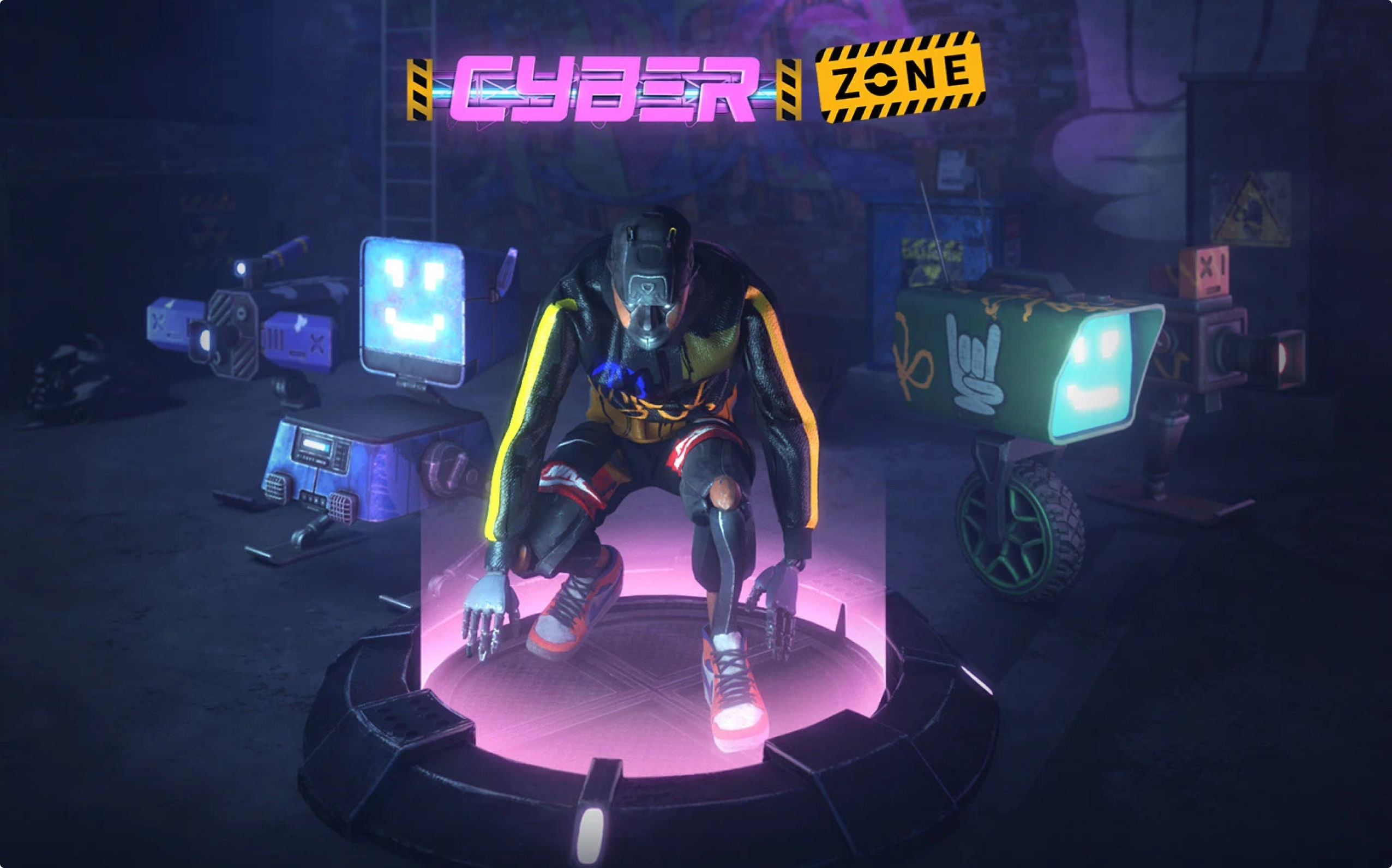
What is Cyber Zone?
Cyber Zone is a fully playable 5-reel slot game set in a neon-drenched cyberpunk dystopia. The project spans the entire creative pipeline,from initial mood boarding and character design, through 3D modeling and animation, to final UI integration and game logic.
The brief was simple and brutal: build an immersive, premium-feeling slot game that feels unlike anything else on the market. The answer was a living, breathing environment where a lone figure stands watch in the rain while the world behind her pulses with glitch-lit signage and holographic debris.
Depth in a genre of flat surfaces
Most slot games treat their background as wallpaper. The visual language is established by a small set of symbols, a UI chrome, and a static illustration behind the reels. The game mechanic and the world it lives in are never truly unified.
The answer was a layered spatial architecture,treating the screen not as a canvas but as a diorama. Foreground, mid-ground, and background planes each have their own depth, parallax logic, and lighting pass. The slot reels occupy the mid-ground, framed by the environment rather than placed on top of it.

From sketch to shader
Every asset,symbol, character, environment prop,followed the same five-stage pipeline. Nothing went into the game engine without passing through all five gates.
The pipeline was optimised for non-destructive iteration. Lighting rigs were separated from geometry so that colour passes could be changed without re-baking every texture. This paid off significantly when the final UI palette shifted from a colder blue- white to the warmer magenta-cyan duality you see in the shipped game.
Building the world
The game environment is a back-alley node in a sprawling mega-city. Layers of dilapidated signage in a fictional East Asian script stack up behind crumbling concrete platforms. Neon bleeds through fog. A lone figure,the character,stands at the boundary between the playable zone and the deeper world.
Foreground
Glowing platform edges, particle effects, close-range props. Highest polygon density. Renders at full resolution.
Mid-ground
The slot reel frame, character, and interactive UI overlay. Core gameplay plane. Lit separately to pop against background.
Background
City skyline, signage, atmospheric haze. Rendered at lower fidelity with a dedicated glow pass. Parallax-offset on idle animation.
The environment was built in 3D software, then rendered as layered 2D assets that could be composited efficiently in the game engine. This gave the visual fidelity of real 3D depth without the runtime cost of a fully real-time 3D scene.

The watcher
The character needed to feel like a resident of this world, not a mascot pasted onto it. She wears the aesthetic scars of the setting: worn tactical gear, a subtle cybernetic glove, short hair damp from the ever-present drizzle.
She performs idle loops, reacts to wins, and transitions between the base game and bonus modes without breaking the environmental illusion. This required careful rigging decisions ,her skeleton needed to be expressive enough for reactive animation but light enough to run without jank during gameplay.

The reel symbols
Each of the game's symbols was modelled in 3D and rendered with its own lightingpass. The symbol set spans five tiers,low-value tech debris (drone, VR visor, pistol)up through high-value collectibles (a crystalline orb, a broken heart, a spade carved from neon) and the signature WILD,a scuffed transit case stencilled with glowing letters.
Symbols were designed to read at three sizes: full-frame, thumbnail, and miniature (as they appear in win-line overlays). Silhouette clarity was the primary constraint,secondary detail exists only where it reinforces the read at small scale.
Low value
Drone · VR Headset · Pistol

High value
Crystal Diamond · Glitch Star

Special
WILD Case · Scatter

What shipped
The shipped game includes four primary screen states: the idle environment loop, the active base game, the free-spin bonus mode (with a shifted lighting palette,the environment cools from cyan to a deeper violet), and the win presentation screen.
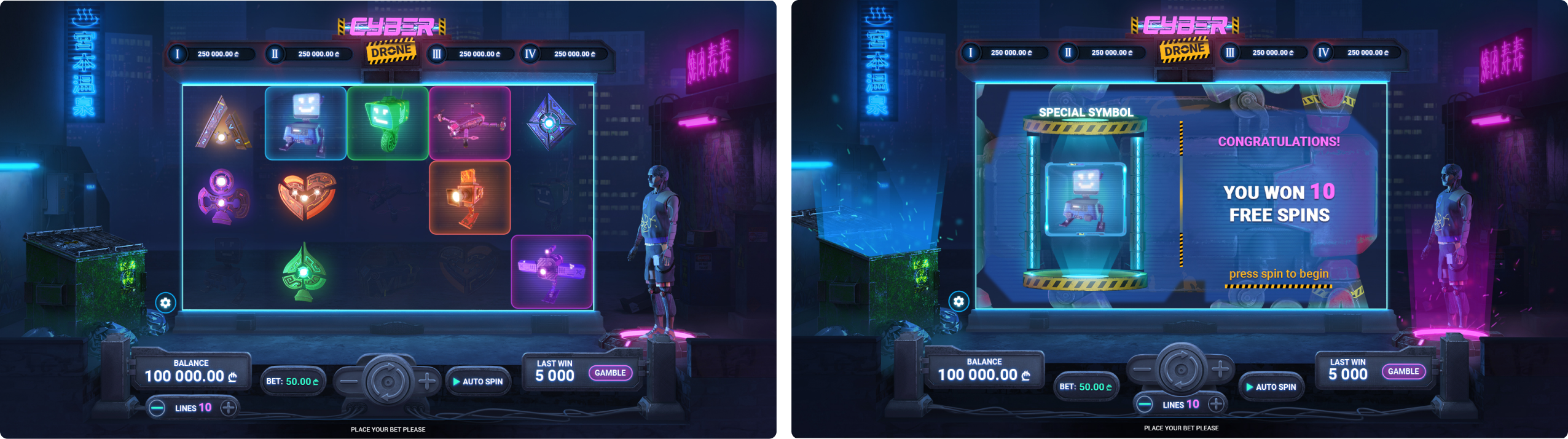
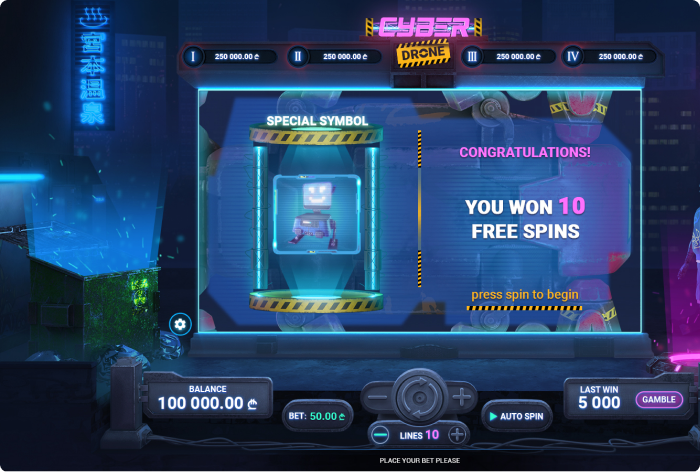
The project delivered a full production-ready game with a visual identity cohesive enough to function as its own IP. The character, world, and UI system are extensible,designed from the start so that future game variants could inherit the visual language without rebuilding from scratch.