
Spatial & Parametric Explorations
A collection of experimental works exploring computational design, generative systems, and spatial relationships through parametric modeling and algorithmic thinking.
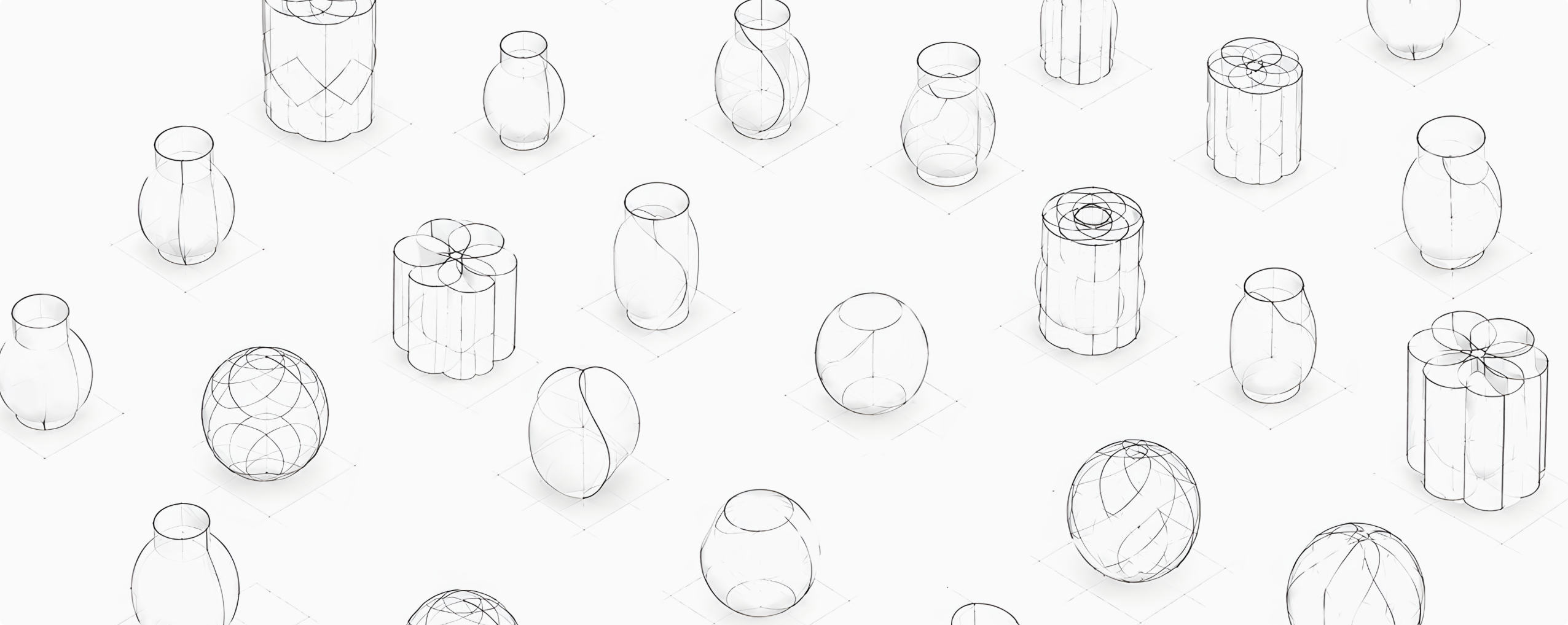
Bridge of Peace,Parametric Reconstruction
Applied Mathematics for Parametric Architecture · Politecnico di Milano
A computational study of Tbilisi's Bridge of Peace, designed by Michele De Lucchi. Rather than trace the arc with a simple polyline, the shape emerges from a curve derived from a catenary graph which naturally adapts to the steel arch converging to a grid of structural ribbons at either shore.
The brief was to reverse-engineer it: not to trace the shape, but to understand the mathematical rules behind it and reconstruct those rules in Grasshopper.

Two Surfaces, One Intersection
The canopy is produced by the intersection of two surfaces. The main shape is generated by taking a curve derived from a sine graph and revolving it around a horizontal axis. The cutting shape is a second surface a different sine curve extruded along the Y-axis which intersects the first.
The boolean difference between the two surfaces produces the characteristic wave. Neither surface alone gives the form, it only appears at their intersection.

Building the Logic
Define the sine profile
A sine function is used to generate the base curve. Amplitude, frequency, and phase are exposed as sliders,these are the primary controls for the whole form.
Revolve to create the main surface
The sine curve is revolved around a central vertical axis to produce the primary canopy shape,a surface of revolution with a wave profile.
Extrude the cutting surface
A second sine curve is extruded along the Y-axis to form the cutting body. Its own parameters can be adjusted independently.
Boolean intersection
The two surfaces are intersected. The result is the undulating canopy geometry. This is the step that defines the characteristic edge profile.
Tessellate the surface
Horizontal planes aligned on the X-axis slice the surface at regular intervals. The intersections define the structural rings. Panels are subdivided from this grid,each one unique in size, all derived from the same parametric rules.

Digital Stereotomy
Geometrical Complements of Graphic Representation · Politecnico di Milano
Stereotomy is the discipline of cutting stone into interlocking forms. A computational take on the Renaissance,a geometry-first approach to structure, where every joint is cut to fit without fasteners, relying entirely on geometry and gravity.
The brief was a reverse-engineering of this problem. Design a pavilion resolved entirely into one fabrication-ready set,each component drawn at full scale, fully annotated. A total inventory of 96 uniquely shaped voussoir blocks.
Tesselation of arch...

Spherical Pavilion
The pavilion derives its form from the subdivision of a sphere into a recursive triangulated mesh. Each triangle is a structural plate,self-bracing by geometry alone, eliminating the need for secondary framing. The sphere is truncated at ground level, creating a stable base ring from which the shell rises.
Parametric subdivision strategy
A geodesic frequency-4 icosahedron was used as the base topology. Each face was further subdivided and projected back onto the sphere surface to maintain uniform curvature. The resulting panels fall into three repetitive tile types, allowing fabrication from a minimal set of moulds.
Panel optimisation
Panel dimensions were constrained to fit standard sheet material sizes. A planarisation algorithm flattened each curved triangle to within a 3mm tolerance, enabling CNC cutting without compound bending. Panels with higher angular deviation received a subtle ridge fold to restore stiffness.
Assembly and jointing
Panels connect via a shared aluminium extrusion at each edge. The extrusion profile was designed to accept panels from both sides simultaneously, so the entire shell can be assembled from the outside,no interior scaffolding required. Hub nodes at each vertex are cast as single pieces to manage tolerance stack-up across six converging edges.
Material and atmosphere
The shell is clad in translucent polycarbonate panels with a white opaline finish. Internally lit at night, the pavilion reads as a glowing lantern,a deliberate reversal of the solid mass implied by the spherical form. During the day, diffused light filters through the panels, casting a soft triangulated shadow grid across the interior floor.

These projects are from an earlier period, architectural school, 2018–2022. The software is different now, and so is the domain. But the underlying approach, break the system into its parts, understand how each part behaves, build from rules rather than from manual shaping, is the same one that shapes how I work in product design today.